
Sunday, January 1, 2012
Animal Strategies For Survival


Monday, December 19, 2011
Fruits

The fruit and vegetables that we eat contain starch, sugar and other foodstuffs that the plants have stored up for their own use. Botanically speaking, fruits are formed from the pollinated flowers of plants. They always contain seeds. The term vegetable is generally used in amore loose way, often simply referring to plants eaten with the main course of the meal. This can cause some confusion. Cucumbers, marrows, peppers and tomatoes are commonly considered vegetables, although to the botanist they are in fact fruits.
Almost juicy fruits are rich in sugar and therefore quite sweet when they are ripe. Some also store starch and oils. These food reserves are not consumed by the plants themselves, but serve to attract animals that eat the flesh and scatter the seed. Most commercial fruits are obtained from trees and shrubs, although some important one, such as strawberries and pineapples, come from herbaceous plants. A few fruits are still gathered mainly from the wild, but the majority is now cultivated in plantations or orchards and, as with the vegetables, many are now larger and tastier than their ancestral forms.
Wednesday, December 7, 2011
Nuts


Walnuts, pecans and almonds, for example, are the equivalents of peach or plum stones, and until they fall from the trees they are enclosed in tough, leathery cases that correspond to the flesh of the peach or plum. Even the hard shelled coconuts are also the inner parts of the fruit, although here the outer part is thick and fibrous – it is used for coconut matting. Brazil nuts are actually hard shelled seeds that are obtained from ball shaped woody fruits.
Ground nuts or peanuts are the seeds of a leguminous plant, carried in pods. In all these examples, the parts that we actually eat are the seeds or kernels- the embryonic next generation of plants and their food reserves.
Tuesday, December 6, 2011
Unusual Adaptation


Friday, October 21, 2011
Mosses, Ferns and Conifers
Mosses
 Mosses and the closely related liverworts carry spores in stalked capsules. The capsules form only after the union of male and female sex cells. As in ferns the cells need moist condition so mosses flourish mainly in damp environment.
Ferns
 Ferns generally carry their spores in little capsules under the leaves. The related horsetails carry their in fleshy cones at the tips of the stems. Although the reproductive process needs water, mature ferns can survive in dry places.
Conifers
 Conifers bear sees on the scales of their cones. The cones are small and soft at first, but swell and become woody after pollination. When the seeds are ripe the cones either open slightly or fall to pieces to release them. Conifers are the best known of the cone bearing plants, known as gymnosperms.

Ferns

Conifers

Thursday, October 13, 2011
The Plants

Most animals stop growing when they reach maturity and each species has a fixed shape. But plants go on growing throughout their lives and although the leaves and flowers of a particular species generally have a fixed shape, the overall shape and size of the plant can vary a good deal according to its situation.
Leaving aside the flowers or other reproductive organs, a typical plant has three main regions – root, stem and leaf. The root anchors the plant and absorbs water and dissolved minerals from the soil by means of osmosis. Growth takes place by elongation of the cells just behind the tip and this forces the root down. Delicate root hairs just behind the growing regions absorb the water and pass it to tubes in the centre of the root.
The stem which may be soft or woody carries water and dissolved minerals from the roots to the leaves through a ring of tubes. Another set of tubes carries manufactured food down from the leaves and distribute it around the plant. The stem also arranges the leaves in the most efficient way for catching sunlight and in flowering plants, displays the flowers in the best position for achieving pollination. The leaves are the plant’s food factories. They are usually flat and have a number of veins. Continues with the tubes in the stems, the veins carry water to the leaf tissues for photosynthesis and also carry away the manufactured food. The undersides of the leaves have thousands of microscopic breathing pores that allow carbon dioxide in and oxygen out. They also release a lot of water vapor by evapo-transpiration.
Wednesday, September 7, 2011
Truffles, Gills and Pores, Lichens
Truffles

Truffles are subterranean fungi with solid, globular fruiting bodies. They grow mainly in broad leaved woods. The perigord truffle of southern France is a much prized and very expensive delicacy. The traditional way of finding truffles is to train pigs or dogs to sniff them out. Most attempts at cultivating truffles commercially have failed.
Gills and Pores
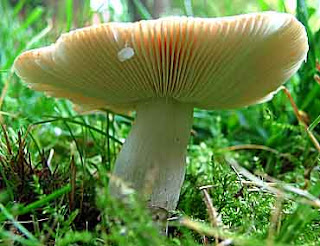 The typical mushroom gets its food from decaying matter in the ground. Its fruiting body is spherical when it first bursts through the soil, but it quickly expands to form a cap and stalk. The latter, often called the stipe, may have a ring showing where the rim of the cap was originally attached and there may be a cup or volva, at the base. Under the cap, most species bear numerous fragile gills arranged like spokes in a wheel. The gill surfaces release millions of spores, the equivalent of seeds in flowering plants. Other mushrooms looks more like sponges, scattering their seeds from thousands of minute pores.
Lichens
 Lichens are among the hardiest of all organisms, growing in some of the hottest and coldest places. They clothe much of the arctic tundra. Each of the many species is actually a combination of a fungus and an alga. The alga can exist along, but the fungus cannot, so lichens are regarded as special kinds of fungi that rely on algae to provide much of their food.

Truffles are subterranean fungi with solid, globular fruiting bodies. They grow mainly in broad leaved woods. The perigord truffle of southern France is a much prized and very expensive delicacy. The traditional way of finding truffles is to train pigs or dogs to sniff them out. Most attempts at cultivating truffles commercially have failed.
Gills and Pores
 The typical mushroom gets its food from decaying matter in the ground. Its fruiting body is spherical when it first bursts through the soil, but it quickly expands to form a cap and stalk. The latter, often called the stipe, may have a ring showing where the rim of the cap was originally attached and there may be a cup or volva, at the base. Under the cap, most species bear numerous fragile gills arranged like spokes in a wheel. The gill surfaces release millions of spores, the equivalent of seeds in flowering plants. Other mushrooms looks more like sponges, scattering their seeds from thousands of minute pores.
Lichens
 Lichens are among the hardiest of all organisms, growing in some of the hottest and coldest places. They clothe much of the arctic tundra. Each of the many species is actually a combination of a fungus and an alga. The alga can exist along, but the fungus cannot, so lichens are regarded as special kinds of fungi that rely on algae to provide much of their food.
Subscribe to:
Posts (Atom)