Showing posts with label Climate. Show all posts

Tuesday, January 18, 2011

Climate & Atmospheric circulation

             Whereas the weather anywhere on Earth can fluctuate day by day, even hour by hour, in ways that are very hard to predict in detail, climate describes the general weather conditions of a location, season by season, year by year, averaged out to something that is constant and predictable. That is not to say that the climate has remained constant over geological time scales. There have been huge variations with the changing composition of the atmosphere, the output of the Sun and the changing positions of continents and ocean currents. For example, the onset of the Indian monsoon can be timed as coinciding with the initial uplift of the Himalayas which drive it. The climate is bound to change in the future too, with or without human help.


   The different regional climates on Earth are governed by atmospheric circulation and to some extent by oceans. Both are driven by heat from the Sun. the cells of atmospheric circulation reach several kilometers up into the troposphere. The deepest, called the Hadley cell, rises at the equator ad transports warm air north and south, returning cool warm air both north and south, returning cool air nearer the surface. The circulation continues across mid latitudes in the lower Ferrel cell. Above that, 5-10 Km high, and not affected by friction from the land’s surface, are jet streams. They form a series of constantly shifting waves around regions of low and high pressure.
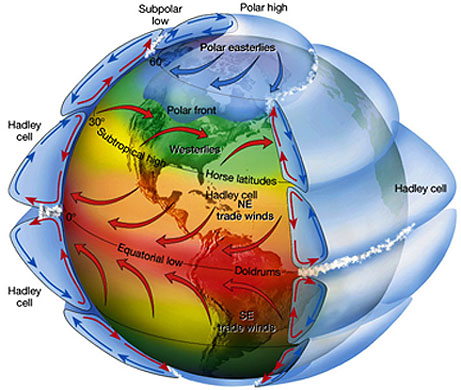
              

           The Ferrel cell underneath thus becomes complicated by the Eddies. In a polar cell cold air sinks, flows out and is replaced by warmer air from above. Tropical and polar air meets at the polar front. Where warm air rises above cooler air to form a front, moisture in it condenses to form clouds and heavy rain and low pressure system that often sweeps in over Britain from the Atlantic. The position of the jet stream is important in determining whether the rain will fall on Iceland or London.

Saturday, January 15, 2011

Climate Change

       
         There have clearly been many variations in the Earth’s climate over and above those produced by the cycles and wobbles of its orbit. Some changes are due to variations in the radiation reaching Earth from the Sun. over its life time so far, the Sun has been getting slowly brighter, but Earth has compensated for this by lowering carbon dioxide levels and reducing the greenhouse effect. The sun also has periods of low sunspot activity, known as Maunder minima, during which its radiation falls by a few percent. One such period caused the “little ice age” between 1530 and 1850, when fairs were held on the frozen river Thames.


            Long term trends in climate are very difficult to measure against the back ground of seasonal and annual variation. But there is evidence to suggest the average world temperatures have risen by about 0.5 degree C during the last century. This follows closely the increasing levels of carbon dioxide caused by the large scale clearing of the world’s forests and the burning of fossil fuels. Climate models in computers mostly agree that, if the present trend continues, the overall climate could warm by about 2.5 degree C by the year 2050.


         That may not seem much, but this is an average figure and local variations could be much more extreme. Some models suggest that the climate will become more polarized, with droughts in the tropics and more rainfall and storms in temperate zones.