If the Earth were a smooth solid and not rotation, understanding wind systems would be easy. Heat would rise in the equatorial regions and warm, high level winds would blow due north and south returning towards the equator as cool winds at the surface. But the earth is spinning and has oceans and continents, hence the more, complex patterns. The earth’s rotations pull the equator bound winds to the west, creating the trade winds from the northeast in the region of the Tropic of Cancer and from the southeast at the Tropic of Capricorn. Other circulation cells provide the prevailing westerlies in the Northern Hemisphere and easterlies in the Southern Hemisphere. This is further complicated by the continents. During the Northern Hemisphere winter, cold continental masses of Asia and North America. In July those continents are warmer and the air flow is reversed. The most spectacular example of this is the monsoon; warm, moist air blows into Asia from the Indian Ocean, depositing heavy rain as it crosses the Indian subcontinent and rises over the Himalayas.
Showing posts with label atmosphere. Show all posts
Monday, January 24, 2011
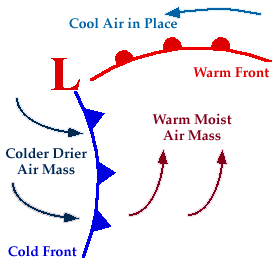
Global winds and Weather Fronts
If the Earth were a smooth solid and not rotation, understanding wind systems would be easy. Heat would rise in the equatorial regions and warm, high level winds would blow due north and south returning towards the equator as cool winds at the surface. But the earth is spinning and has oceans and continents, hence the more, complex patterns. The earth’s rotations pull the equator bound winds to the west, creating the trade winds from the northeast in the region of the Tropic of Cancer and from the southeast at the Tropic of Capricorn. Other circulation cells provide the prevailing westerlies in the Northern Hemisphere and easterlies in the Southern Hemisphere. This is further complicated by the continents. During the Northern Hemisphere winter, cold continental masses of Asia and North America. In July those continents are warmer and the air flow is reversed. The most spectacular example of this is the monsoon; warm, moist air blows into Asia from the Indian Ocean, depositing heavy rain as it crosses the Indian subcontinent and rises over the Himalayas.
Thursday, January 13, 2011
Heat circulation
The weather system of the troposphere is constantly circulating like the cogs in a giant solar powered engine. The earth receives most solar energy around the equator and this causes evaporation and convection. Replacement air is drawn in from north and south and convection cells transfer the heat in jet streams away from the equator. They descend in a band of high pressure systems about 30degree N and 30 degree S of the equator. That produces warm southwesterly winds near the ground. As the heat continues to move out from the equator, the next series of convection cells are completed by updrafts and accompanying low pressure systems at latitudes of about 60 degree N and S. These are often associated heavy rains or snow.
The poles are capped by relatively stable, high pressure systems. At the same time, the rotation of the Earth produces the Coriolis force which deflects weather systems to the east in the Northern Hemisphere and to the west in the Southern Hemisphere. It is against the backdrop of this global heat engine and consequent circulatory systems that weather patterns unfold.
Wednesday, January 12, 2011
An Evolving Atmosphere
The first atmosphere of the Earth was very different from that of today. There was no free oxygen but high levels of carbon dioxide produced by continual volcanic eruptions. This provided the original green house effect, allowing the Earth to be warmed by the trapped rays of the Sun. By 1800million years ago oxygen began to be produced by algae photosynthesizing, and first appeared in the atmosphere.
The amount of oxygen continued to increase but was still probably only two thirds of the present level when the first animals appeared 670 million years ago. Only after the ozone layer formed did it become safe for animals to leave the sea and respiration became mainly aerobic.
During the Mesozoic era there may have been more oxygen than today as a result of algal blooms. It cannot have been more than about 24 percent or forest fires would have raged out of control. One theory suggests that dinosaurs achieved their large size thanks to abundant oxygen ad became extinct when levels fell. The other side of the story of increasing oxygen has been one of decreasing carbon dioxide.
As the Sun warmed, life kept pace with it by consuming the greenhouse gases and converting carbon dioxide into thick deposits of limestone, chalks and fossil fuels. Now humans are burning those fuels, releasing the carbon dioxide back into the air. And the forests that recycle it back into oxygen and organic matter are being felled, so the greenhouse effect is increasing. Various predictions suggest that average global temperatures could rise by several degrees as a result.
Subscribe to:
Posts (Atom)