Thursday, January 13, 2011

Heat circulation


                  The weather system of the troposphere is constantly circulating like the cogs in a giant solar powered engine. The earth receives most solar energy around the equator and this causes evaporation and convection. Replacement air is drawn in from north and south and convection cells transfer the heat in jet streams away from the equator. They descend in a band of high pressure systems about 30degree N and 30 degree S of the equator. That produces warm southwesterly winds near the ground. As the heat continues to move out from the equator, the next series of convection cells are completed by updrafts and accompanying low pressure systems at latitudes of about 60 degree N and S. These are often associated heavy rains or snow. 
    

      The poles are capped by relatively stable, high pressure systems. At the same time, the rotation of the Earth produces the Coriolis force which deflects weather systems to the east in the Northern Hemisphere and to the west in the Southern Hemisphere. It is against the backdrop of this global heat engine  and consequent circulatory systems that weather patterns unfold.

Wednesday, January 12, 2011

An Evolving Atmosphere

            
         The first atmosphere of the Earth was very different from that of today. There was no free oxygen but high levels of carbon dioxide produced by continual volcanic eruptions. This provided the original green house effect, allowing the Earth to be warmed by the trapped rays of the Sun. By 1800million years ago oxygen began to be produced by algae photosynthesizing, and first appeared in the atmosphere.

                The amount of oxygen continued to increase but was still probably only two thirds of the present level when the first animals appeared 670 million years ago.  Only after the ozone layer formed did it become safe for animals to leave the sea and respiration became mainly aerobic.

           
    During the Mesozoic era there may have been more oxygen than today as a result of algal blooms. It cannot have been more than about 24 percent or forest fires would have raged out of control. One theory suggests that dinosaurs achieved their large size thanks to abundant oxygen ad became extinct when levels fell. The other side of the story of increasing oxygen has been one of decreasing carbon dioxide.

                
           As the Sun warmed, life kept pace with it by consuming the greenhouse gases and converting carbon dioxide into thick deposits of limestone, chalks and fossil fuels. Now humans are burning those fuels, releasing the carbon dioxide back into the air. And the forests that recycle it back into oxygen and organic matter are being felled, so the greenhouse effect is increasing. Various predictions suggest that average global temperatures could rise by several degrees as a result.

Tuesday, January 11, 2011

Atmosphere


Atmosphere
                The Earth is shrouded in a thin veil of gas called the atmosphere. At sea level it provides the air we breathe, the wind and the weather, but with increasing height, it becomes more and more rarefied, slowly blending into the virtual vacuum of space. The atmosphere has no easily defined top; technically the height at which space shuttles orbit is within the atmosphere. Our atmosphere has evolved so that there is both carbon dioxide and oxygen held in balance by photosynthesis and respiration. This combination supports life on Earth, making it unique amongst the planets of the Solar System.
Thermosphere
                Above about 450 Km any gas molecules are on their way out into space, so this is called the exosphere. Below that, down to about 80 Km
Mesosphere
                The mesosphere down to 50 Km, is too low to be warmed by direct radiation and too thin to be warmed b y convection. It includes most of the ionosphere, consisting of variable layers of atoms with one or more electrons stripped off to give them and electrical charge. Certain parts of the ionosphere can reflect shortwave radio signals and filter out X rays from space.
Stratosphere
                From about 15-50 Km above us is the stratosphere, at temperatures below 0 degree C. violent volcanic eruptions can propel gas and dust to this level, where they slowly spread around the globe. But generally, the stratosphere remains horizontally stratified, with little vertical mixing. This layer screens out most solar ultraviolet radiation.
Troposphere
                The bottom 15Km of the atmosphere, the layer in which weather condition occur, is the troposphere. It is warmed by radiation from the Earth and is therefore normally warmed from the bottom. The boundary with the stratosphere varies from about 10 Km at the poles to 20 Km at the equator.

Monday, January 10, 2011

Ocean Temperature


The top two meters of the oceans store more heat than the entire atmosphere. So the oceans are a vital buffer in keeping the Earth’s climate equitable. Still tropical waters tend to stratify as they warm, with the hottest water floating on the surface reaching temperatures of up to 25C, while 1000m down, they are a meager 5.C and below this they can plummet to 1-2 degrees.

        These layers are identified as the epilimnion, thermocline and hypolimnion.  Only when they are stirred by wind and currents r become dense due to salt to different layers mix. One possible outcome of global warming might be an even greater stratification of the oceans, polarizing climate zones still further. As it is warm ocean currents bring mild wet weather to some parts such as North West Europe, while cold currents with low evaporation rates cause cold winters in eastern Canada and desert like conditions in Chile, southwest Africa and Western Australia.

 Where cold and warm currents meet, they interact; forming eddies and fronts very similar to those of weather systems. As warm water mixes with nutrient rich cold water, ideal conditions for rapid plankton growth are created, sometimes resulting in spring blooms of Phyto-plankton.  Ocean temperatures and circulation are so important to climate that the complex computer simulations used for weather forecasting have to expend more computer power in monitoring the ocean than the atmosphere.

Saturday, January 8, 2011

The Hydrological cycle

                The world’s water is forever going to round in circles not just I ocean currents, but between atmosphere and ocean by evaporation from lakes, rivers and seas, transport in clouds precipitation as rain or snow , seepage from ground water and lakes, and flow of rivers. This is the hydrological cycle. Ninety seven percent of the world’s water is contained in oceans and saline lakes; the remaining three percent is fresh water. Three quarters of fresh water is stored as ice and nearly one quarter is in underground aquifers. All rivers, lakes and clouds contain less than one percent of the world’s fresh water, or 0.03 percent of the total

Friday, January 7, 2011

Waves and tides

 The Earth’s layer of water making up the oceans, often referred to as the hydrosphere, will according to the laws of gravity finds its own level. The Earth’s gravity however, varies over its surface according to the density of the rocks beneath; hot, low density rock, rising in a convection current through the mantle, will lead to a weaker gravitational pull and hence less water above it, where as  thick, cold, dense rock will have greater gravitational pull and so will have more water above it. This accounts for variations of several meters revealed by the satellite surveys.

The stronger influence on the height of the oceans is the gravitational pull of the Moon, which causes a bulge of ocean that is pulled towards it. A similar bulge appears on the opposite side of the globe, as if in a falling away response, which is caused by the Earths spin. The result is two high tides during the course of a day separated by about 12 hours as the Earth completes its orbits. Since the moon is also in orbit, the time of high tide varies by just under an hour each day. The sun also exerts a gravitational influence on the tides when it pulls in the same direction as the Moon the tides are at their largest and are known as spring tides. When the sun pulls at right angles to the Moon it has a diluting effect and the tidal range is less; this causes neap tides the lowest high tides.
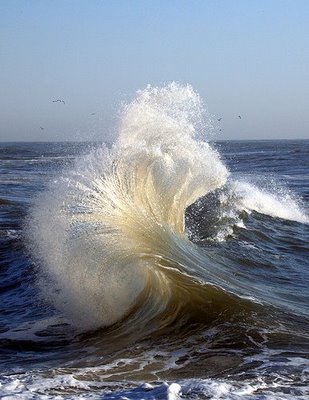
 The surface of the ocean is constantly stirred by the wind, producing waves of transverse nature. A wave may travel for many Kilometers, and each particle of the water within it moves in a small circular motion. As the wave comes into shallow water of the shore, there is a change in speed, with the bottom of the wave slowing down at a greater rate than the top water. The top part in effect over takes the bottom, causing the wave to break. Depending on the angle at which the wave hits the shallow water, there can also be a change in direction of the wave since refraction will occur. The return flow of the water down the beach becomes a current or undertow that can be a danger to the swimmers or surfers.

Thursday, January 6, 2011

Ocean Currents and salinity

 The sea is salty. If all the oceans evaporated and the salt spread out evenly, it would form a solid layer of75 meter thick. It is likely that that the first oceans were of almost fresh water. Four billion years of rain, rivers and erosion have progressively washed more and more soluble material out of continental rocks and down to the sea.


The salinity varies widely from place to place. In the Baltic there is low evaporation and a regular input of fresh water from melting snow and its salinity is about 5000 parts per million. In the Red Sea and Persian Gulf, however, it can exceed 40,000 ppm. Salt plays an important role in the global transport of ocean currents.As water evaporates, the sea becomes saltier and as a result denser. Eventually, particularly if it cools, the salt water sinks downwards. In this way, salt and sunshine drive great conveyor belts that carry heat from equatorial waters in surface currents and return salt in deep currents.


The best example of this is in the North Atlantic, where the Gulf Stream brings rain and warm weather to western Europe and the salt returns south at depth. If this conveyor belt is disrupted, it can trigger an ice age.Ocean currents depend on the positions of the continents, and continental drift has caused major climatic change in the past.


About 30 million years ago an eastward circumpolar current established itself around Antarctica, isolating the continent from other weather systems and leading to the development of the ice cap.  A modern example of the effects of changing currents is El Nino (means The Child, so called because it occurs at Christmas) a warm current that can develop in the pacific and move towards the coast of Peru. It causes disruption to fisheries and triggers equatorial drought and tropical storms.