Showing posts with label solar system. Show all posts

Friday, July 9, 2010

Multiple Stars

    Multiple stars
Most stars have companions. Two, three or more stars, born from the same gas cloud may orbit each other. Some giant stars are in contact as they orbit each other. The members of other multiple systems are so far apart, they may not belong to one system.
The more massive star of a pair will go through its life cycle more rapidly, and its death may be affected by its companion. In some binary systems, one star has aged until it has become a white dwarf. When the second star at last ages and swells, gas from its out layers can be sucked onto the surface of the white dwarf, which flares up as a bright , seemingly “new” star,  a nova, over 100,000 times brighter than the Sun. the white dwarf blows away the excess matter and subsides.
But if the mass of the white dwarf is above a certain limit, there can be a much more massive explosion a super nova but caused in a different way from those discussed before.


Friday, June 25, 2010

Unknown Planet in the known Solar System

Could there be a tenth planet beyond Pluto?  Neptune was “discovered” on paper in 1846, a year before it was seen; its orbit was calculated from its gravitational effect on the orbit of Uranus. But it did not seem to explain all the disturbance of Uranus that was observed and the search for other planet began. It was not until 1930 that Clyde Tombaugh discovered Pluto. Pluto does not seem to be massive enough to be responsible for all the gravitational disturbance of Uranus and Neptune that has been observed, and at least one more planet may lie beyond Pluto.
Computer analysis of the orbits of Uranus and Neptune gives some “best bets” for the distance and mass of possible planets, some predictions indicate a planet up to five times the mass of the Earth, several times as far from the Sun as Neptune, and possibly in a tilt orbit.
The existence of Charon was not suspected until 1978, when a small bump was noticed on Pluto’s image on a photographic. From 1985 to 1990, Charon’s orbit was positioned so that the satellite passed repeatedly in front of and behind Pluto. This revealed a great deal about both bodies. They both revolve about their common centre of gravity, a point in space between them. Likewise there is definitely more chances for another planet in the Solar System.

Tuesday, June 22, 2010

Solar System

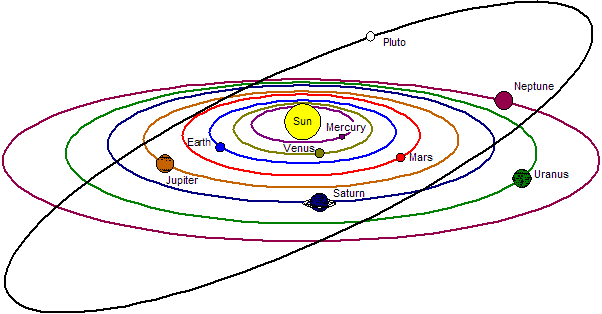
The solar system is dominated by the gravitation of the Sun. About 99.85 percent of the mass of the system resides in the sun, 0.14 percent in the planets and the rest in satellites, asteroids, comets and meteoric matter that also circle the central star.
The planets all circle the sun in the same direction, and almost exactly the same plane. Viewed from “above” that is the side on which the Earth’s Northern Hemisphere lies, the direction of the planetary motion is counter clockwise. The asteroids, or minor planets, do the same. But the orbits of the comets are oriented randomly. They can approach the sun, and recede from it, at any angle.
The furthest planet from the Sun, normally, is Pluto, which at its maximum reaches 7,375 million Km from the Sun. but the furthest members of the sun’s group are believed to be an enormous group of unseen comets which form Oort’s Cloud, named after the Dutch astronomer who deduced their presence. The comets spend most of their time in the outermost reaches of their orbits, at a distance of about two light years from the Sun. They mark the true outer limit of the Solar System, the region in which the Sun’s gravity becomes feebler than that of its neighboring stars

Wednesday, June 16, 2010

The birth of Solar System

When the Sun was born about 4.6 billion years ago, it was encircled by a disc of matter, left over from the parent cloud. Such a cloud would consist of gas, mostly hydrogen and helium, mixed with solid grains. In the cooler outer regions of the cloud, the grains would consist of rock matter and of –“ices’-frozen water, carbon dioxide, methane and ammonia. The ices could relatively easily be turned into vapour, so in the inner regions of the cloud only the rock material condensed as it was warmed by the newly born star.
Grains of dust in the disc collided, accumulated and built up into small bodies called planetoids. These rapidly swept the surrounding space clear of the remaining dust. The inner planetoids consisted of rock, and were fairly small: in the outer system, the planetoids also included the icy materials. Because they were more massive, the outer planetoids gathered large atmospheres of hydrogen and helium around them. The smaller inner planetoids could not retain atmospheres: the warmth from the central star also helped to drive off these light gases. The process of planetoid formation was repeated in miniature around the larger outer planets, which formed systems of numerous satellites, or moons.
For hundreds of millions of years the young planets and moons were bombarded by leftover debris. Finally the planetary system became established: in our case, with four small, rocky inner planets, and four giant outer planets, mostly consisting of hydrogen and helium, and their systems of moons; an odd ball rocky planet, Pluto, in the “wrong’ place at the edge of the system; and assorted debris of rock and ice- the asteroids, comets and meteoric bodies.