Showing posts with label sun and the planets. Show all posts

Friday, June 25, 2010

Unknown Planet in the known Solar System

Could there be a tenth planet beyond Pluto?  Neptune was “discovered” on paper in 1846, a year before it was seen; its orbit was calculated from its gravitational effect on the orbit of Uranus. But it did not seem to explain all the disturbance of Uranus that was observed and the search for other planet began. It was not until 1930 that Clyde Tombaugh discovered Pluto. Pluto does not seem to be massive enough to be responsible for all the gravitational disturbance of Uranus and Neptune that has been observed, and at least one more planet may lie beyond Pluto.
Computer analysis of the orbits of Uranus and Neptune gives some “best bets” for the distance and mass of possible planets, some predictions indicate a planet up to five times the mass of the Earth, several times as far from the Sun as Neptune, and possibly in a tilt orbit.
The existence of Charon was not suspected until 1978, when a small bump was noticed on Pluto’s image on a photographic. From 1985 to 1990, Charon’s orbit was positioned so that the satellite passed repeatedly in front of and behind Pluto. This revealed a great deal about both bodies. They both revolve about their common centre of gravity, a point in space between them. Likewise there is definitely more chances for another planet in the Solar System.

Tuesday, June 22, 2010

Solar System

The solar system is dominated by the gravitation of the Sun. About 99.85 percent of the mass of the system resides in the sun, 0.14 percent in the planets and the rest in satellites, asteroids, comets and meteoric matter that also circle the central star.
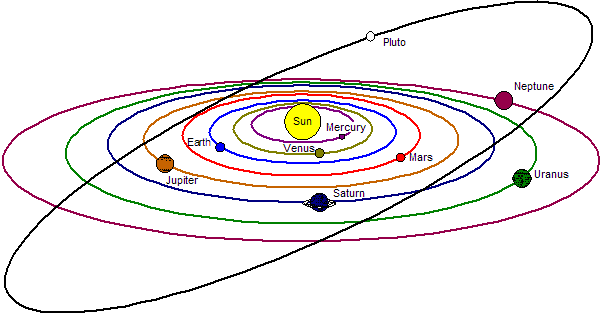
The planets all circle the sun in the same direction, and almost exactly the same plane. Viewed from “above” that is the side on which the Earth’s Northern Hemisphere lies, the direction of the planetary motion is counter clockwise. The asteroids, or minor planets, do the same. But the orbits of the comets are oriented randomly. They can approach the sun, and recede from it, at any angle.
The furthest planet from the Sun, normally, is Pluto, which at its maximum reaches 7,375 million Km from the Sun. but the furthest members of the sun’s group are believed to be an enormous group of unseen comets which form Oort’s Cloud, named after the Dutch astronomer who deduced their presence. The comets spend most of their time in the outermost reaches of their orbits, at a distance of about two light years from the Sun. They mark the true outer limit of the Solar System, the region in which the Sun’s gravity becomes feebler than that of its neighboring stars