Monday, January 31, 2011

Clouds

                Clouds are simply accumulations of condensed water vapour in the air. But their ever changing patterns are quiet revealing as to how and why they formed and what kind of weather they are heralding. There are three basic types of clouds- first described in 1804 by the English chemist Luke Howard: cirrus clouds which are light and wispy, the word deriving from the Latin for “Curl of hair”; cumulus, meaning a pile or heap; and stratus, describing clouds that spread out in a horizontal layer.
                         The height at which clouds form is also important. Cirrus clouds are usually very high- at an altitude of more than 5000 m. their drawn out wisps are a sign of strong winds and changeable weather to come. Middle altitude cumulus clouds include the white, “cotton wool” fair weather clouds, as well as altocumulus clouds, which bring light showers of rain. If they occur at lower altitudes, cumulus clouds can build into heavy rain clouds and dark, anvil shaped cumulonimbus storm clouds. The latter can tower from 300 to 12000 meters and result in thunderstorms.

Monday, January 24, 2011

Global winds and Weather Fronts


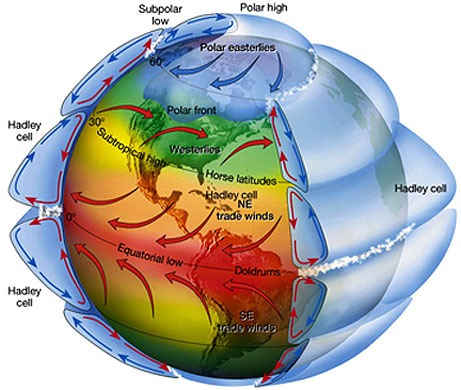
                             If the Earth were a smooth solid and not rotation, understanding wind systems would be easy. Heat would rise in the equatorial regions and warm, high level winds would blow due north and south returning towards the equator as cool winds at the surface. But the earth is spinning and has oceans and continents, hence the more, complex patterns. The earth’s rotations pull the equator bound winds to the west, creating the trade winds from the northeast in the region of the Tropic of Cancer and from the southeast at the Tropic of Capricorn. Other circulation cells provide the prevailing westerlies in the Northern Hemisphere and easterlies in the Southern Hemisphere.  This is further complicated by the continents. During the Northern Hemisphere winter, cold continental masses of Asia and North America. In July those continents are warmer and the air flow is reversed. The most spectacular example of this is the monsoon; warm, moist air blows into Asia from the Indian Ocean, depositing heavy rain as it crosses the Indian subcontinent and rises over the Himalayas.


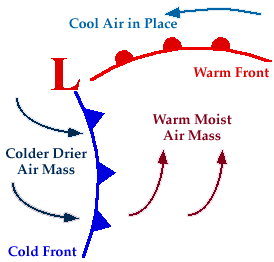
                                             Much of the weather at temperate latitudes is dominated by the interaction between masses of cold and warm air. They meet at what is known as a front, but do not mix. At a warm front, warm air rises above cold, creating a low pressure system. Moisture in the warm air builds into clouds which may produce light precipitation. At a cold front cold air wedges in under warm air, clouds build again, this time resulting in heavier, more prolonged precipitation. As the warm air rises, the front eventually combine and lift off the ground to form what is known as a occluded front. The warm air then rises more slowly, the low pressure system weakens and any precipitation eases off.

Thursday, January 20, 2011

Weather forecasting


        Weather is determined by many factors – atmospheric pressure, humidity, temperature and winds. Small, unpredictable variations in any one of these factors can have cumulative and subsequently major effects on the others and the resulting weather systems. Meteorologists are, however, getting better at prediction the weather several days in advance. To do so several  requires thousands of measurements of existing weather conditions all over the world, from manned and automatic stations on the ground and at sea, from balloons, and from satellites in space. A variety of measuring instruments are used, the most common being the thermometer and the barometer.
     

  Measurements are fed into a super computer which performs calculations based on mathematical models of typical weather system. It calculates what is likely to happen at a series of points on the ground and in the air. The closer together those points are, the more accurate the forecast will be. A weather model can contain data for millions of point in the atmosphere. Even so, details of the forecast are sometimes wrong, but forecasts can generally predict accurately up to a week in advance.

Wednesday, January 19, 2011

Climate Zones, Climate factors and Weather


There have been various systems of classifying climate, some with subsections, but essentially there are eight categories based on temperature and rainfall and thus vegetation. These are tropical, subtropical, stepped, arid, savanna, temperate, marine, continental, and mountainous and sub polar, polar. Within these there are local interactions of ocean and atmospheric circulation, continental position and relief to be considered.


Averaged out over the year, temperatures are closely zoned to latitude. Temperatures in continental interiors tend to be more extreme hotter in summer and colder in winter than latitude would indicate, where as oceans have a moderating influence cooling the tropics but warming higher latitudes. Patterns of rainfall are even more complex, although there is a tendency for continental interiors to be drier at subtropical latitudes but wetter closest to the equator.


               Climate affects whole regions and refers to weather patterns averaged out season by season over decades or even longer. Weather describes how the details of atmospheric conditions change day by day, or hour by hour, and refers to conditions at a much more local level

Tuesday, January 18, 2011

Climate & Atmospheric circulation

             Whereas the weather anywhere on Earth can fluctuate day by day, even hour by hour, in ways that are very hard to predict in detail, climate describes the general weather conditions of a location, season by season, year by year, averaged out to something that is constant and predictable. That is not to say that the climate has remained constant over geological time scales. There have been huge variations with the changing composition of the atmosphere, the output of the Sun and the changing positions of continents and ocean currents. For example, the onset of the Indian monsoon can be timed as coinciding with the initial uplift of the Himalayas which drive it. The climate is bound to change in the future too, with or without human help.


   The different regional climates on Earth are governed by atmospheric circulation and to some extent by oceans. Both are driven by heat from the Sun. the cells of atmospheric circulation reach several kilometers up into the troposphere. The deepest, called the Hadley cell, rises at the equator ad transports warm air north and south, returning cool warm air both north and south, returning cool air nearer the surface. The circulation continues across mid latitudes in the lower Ferrel cell. Above that, 5-10 Km high, and not affected by friction from the land’s surface, are jet streams. They form a series of constantly shifting waves around regions of low and high pressure.


           The Ferrel cell underneath thus becomes complicated by the Eddies. In a polar cell cold air sinks, flows out and is replaced by warmer air from above. Tropical and polar air meets at the polar front. Where warm air rises above cooler air to form a front, moisture in it condenses to form clouds and heavy rain and low pressure system that often sweeps in over Britain from the Atlantic. The position of the jet stream is important in determining whether the rain will fall on Iceland or London.

Saturday, January 15, 2011

Climate Change

       
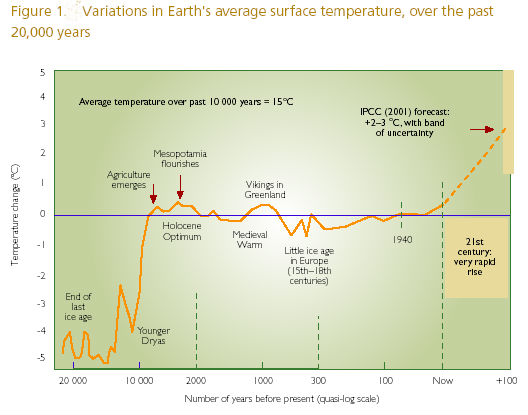
         There have clearly been many variations in the Earth’s climate over and above those produced by the cycles and wobbles of its orbit. Some changes are due to variations in the radiation reaching Earth from the Sun. over its life time so far, the Sun has been getting slowly brighter, but Earth has compensated for this by lowering carbon dioxide levels and reducing the greenhouse effect. The sun also has periods of low sunspot activity, known as Maunder minima, during which its radiation falls by a few percent. One such period caused the “little ice age” between 1530 and 1850, when fairs were held on the frozen river Thames.


            Long term trends in climate are very difficult to measure against the back ground of seasonal and annual variation. But there is evidence to suggest the average world temperatures have risen by about 0.5 degree C during the last century. This follows closely the increasing levels of carbon dioxide caused by the large scale clearing of the world’s forests and the burning of fossil fuels. Climate models in computers mostly agree that, if the present trend continues, the overall climate could warm by about 2.5 degree C by the year 2050.


         That may not seem much, but this is an average figure and local variations could be much more extreme. Some models suggest that the climate will become more polarized, with droughts in the tropics and more rainfall and storms in temperate zones.

Friday, January 14, 2011

Seasons and Climatic Cycles


        The most obvious seasonal variations on Earth are due to the 23.5 degrees inclination of the Earth’s axis to the plane of its rotation around the Sun. This produces hot summers and cold winters as a simple consequence of the different amounts of sunshine received at mid and high latitudes. Neared the equator, seasonal temperature variations are less marked than variations in rainfall, so there the year is often divided into wet and dry seasons. Sri Lanka has two rainy seasons, in spring and autumn, because the equatorial rain belt passes over it twice.


         The most spectacular season is that of the monsoon in southern Asia. Between April and October warm south westerly winds blow in off the Indian Ocean laden with moisture. This is released as extremely heavy rain when the winds rise over the heated land and begin to cool.

        There are climatic cycles over much longer timescales. The eccentricity of the Earth’s orbit varies from nearly circular to more elliptical and back over a period of about 21,000 years. It currently occurs during the Southern Hemisphere summer but that will be reversed in 10,000 years. These cycles all produce long term climatic variations.
Some Climate Extremes:
                The least sunshine occurs at the north and south poles, where the Sun does not rise for 182 days of winter.
                The maximum sunshine received is in the eastern Sahara; more than 4,300 hours a year (97% of daylight hours)
            The coldest place on an average is Plateau station, Antarctica, at -89degrees C.
            The most rainfall in 24 hours fell on Cilaos in the Indian ocean in 1952, about 1870 mm.